Sunday, May 26, 2002 - 12:00
a.m. Pacific
A shared grief: Web's brotherhood of Vietnam veterans eases a
younger brother's loss
By Nancy
Bartley
Seattle Times staff reporter
 |
 |
Rick
Clements of Kenmore holds a picture of his brother Bob, who
was killed in Vietnam in 1969 by what in later years came to
be called friendly fire.
|
|
|
|
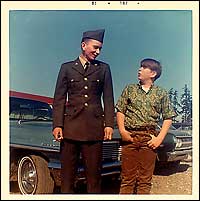
To 12-year-old Ricky Clements, his brother Bob was the coolest. He had
a '66 blue Chevelle and didn't mind taking a kid brother on a ride,
"lighting up the tires" on Renton streets. About two years later, in 1969,
Bob Clements exchanged the high-school days of hot rods and hamburgers for
a crisp, green uniform and a deadly mission in a faraway place called
Vietnam.
Before that year was out, Clements, 21, was dead — another statistic in
one of the nation's most divisive wars. The soldier was a victim of what
is now called friendly fire, but was then passed off without any attempt
at a full explanation.
According to the telegram that arrived just before Christmas, he was
killed when a mortar shot into the jungle to clear out possible enemies
fell short, killing him and his best friend, Jim McCarthy. As it turned
out, there were no enemies in the area.
The round that killed Clements caused 32 years of bitterness for Rick,
now a 45-year-old King County court protection officer. He is only now
getting over the loss, thanks to a chance encounter via the Internet that
changed his Memorial Days forever.
"Such a waste," he said. "They were only kids."
For years he wondered how such a tragedy could have happened to his
beloved brother. Who was responsible? He suspected that his brother served
with machismo-driven commandos who killed him through a careless act, one
they tried to gloss over with a form letter to the family.
Now, Clements said of the sergeant his brother served under, "I just
want to meet him and hug him."
A connection on the Web
It all began when Clements found http://www.thevirtualwall.org/,
a Web site honoring the 58,226 servicemen and women killed in the Vietnam
War. He was stunned to find that Ben Youmans, who served with his brother,
had entered a remembrance.
"We few, we happy few, we band of brothers; for he to-day that sheds
his blood with me shall be my brother," Youmans wrote, quoting
Shakespeare, under Clements' name.
"I got cold chills when I found it," Clements said. Here was a link to
the past, and a sign that someone outside his family cared.
That Web site led him to one for the U.S. Army 35th Infantry Regiment,
1/35th Company B, where he found listings not only for his brother but for
McCarthy — who grew up with Clements in Des Moines — and comments from
their former sergeant, David Muxo.
Rather than the bravado Clements expected, he found the stories shared
were laced with pain. And he realized that those who served with his
brother had also suffered from his loss.
"It mellowed me out a lot," he said.
In his Kenmore home, Clements, a patriotic bear of a man who has an
American flag in Christmas lights over his garage, pores over photos and
letters.
He has tried to contact McCarthy's family but has been unsuccessful. He
and his mother, Helen, who shares his sense of peace at learning more
about Bob's death, plan to attend the July reunion of the 35th Regiment,
to be held in Tukwila.
In the meantime, with every contact he makes with the veterans,
Clements learns more about the brother he lost, and how he died.
Sergeant tells the story
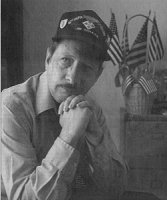
Muxo, the sergeant, is now a Disney World computer programmer in
Orlando, Fla., who also maintains a Web page of Vietnam photos and stories
at http://www.muxo.net.
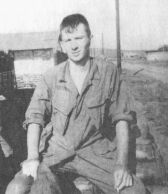
He recalled Bob Clements as a man who
"grumbled like all of us did. Just an average guy, very young."
Clements was 20 when he enlisted, joining a high-risk rifle
reconnaissance platoon led by then- Lt. Jeffrey Rogers.
On Nov. 29, 1969, the platoon moved out early, crossing rice paddies,
then seeking cover in dense bamboo near the Cambodian border. Rogers
called a halt for lunch and Muxo, whose squad was in the point position
that day, sent Clements and McCarthy about 10 yards ahead to watch for the
enemy. They dropped their gear and began to eat.
Anticipating an ambush when the platoon moved forward, Rogers called
for rounds to be fired into the brush ahead. Muxo now says the order was a
good idea, except that the men were sitting too near the target and the
shells would travel over their heads.
Rogers called for the gunners to launch a smoke round, a test to be
sure the artillery was on target.
"We heard it go over and pop well in front of us. We couldn't see it
because of the bamboo, but none of us were worried because it was a good
ways out," Muxo wrote on his Web site.
|
 |
| Bob Clements
|
|
Rogers added another 100 yards to the target. Again they heard the
round, which exploded well out in front of them. To be safe, Rogers asked
for another 100 yards and then called for the high explosives.
Muxo took another bite of cold beans, confident the men were safe.
Soldiers say you can't hear the round that hits you, "but I think Bob
and Jim did," he wrote. The round sailed overhead with a "funny sort of
sound like a swish and a jet sound rolled into one. The next thing I knew
my ears exploded. The pressure of the explosion was intense and the loud
bang left my head ringing."
The sun was obscured by the heavy smoke, and the tropical air was
filled with the sharp smell of sulfur. Then came the sounds of moaning up
ahead.
The men moved quickly through the smoke but it was pointless. McCarthy
was dead and Clements, severely wounded, was being aided by a paramedic
who'd been posted nearby. They were awaiting helicopter evacuation. It
seemed like hours before one came.
"I was standing close to the chopper when they carried Bob toward it.
The wash from the rotors blew the poncho off ... I had nightmares about
that for awhile," he wrote. That night Muxo could almost hear Clements
complaining about having to dig a foxhole — which he hated to do.
Everything reminded the sergeant of the lost men.
For days the platoon members asked themselves what had happened. Why
had the explosive fallen closer than the round of smoke, when it was
always the other way around? What had gone wrong?
Back at Camp Enari, the commanding officer read a letter that had been
sent home to Clements' and McCarthy's parents, saying their sons had died
honorably in battle.
|
 |
| Dave Muxo
|
|
'They will never be forgotten'
For years Muxo — like the younger Clements — was angry about that
letter. The deaths continued to haunt him.
He said he blamed himself, the gunners and Rogers until one day he
heard and accepted the Army Board of Inquiry's explanation: The round that
killed the men was one of a number of defective devices incapable of
traveling the intended distance.
Muxo eventually came to the realization that the lost men had lived and
died honorably.
"They will never be forgotten," he said.
"The most precious thing a leader has is his people," said Rogers, now
a retired colonel living in Connecticut. When there are deaths, "a
professional soldier always carries it with him."
Tomorrow, as they do every Memorial Day, Rick Clements and his mother
will go to the Evergreen-Washelli Memorial Park to visit Bob Clements'
grave.
This year, Rick Clements said, it will be without the anger and hurt
and with a newfound gratitude for those who gave their lives for their
country. And maybe they'll speak of better memories, like Bob's smile, his
laugh or the time he skated down the icy driveway in his tennis shoes and
crashed.
Through the Web site that led to healing, Clements has found a place to
express his feelings to the brother he once had.
"I want you to know I have never stopped thinking about you," he wrote.
"Though the years go by you will always be in my heart."
Nancy Bartley can be reached at 206-464-8522 or nbartley@seattletimes.com.
 Use the time-line above to navigate through different periods