SEATTLE - On the
Vietnam Veteran's Memorial in Olympia, there are the names of
more than 1,000 state residents who didn't come home.
Behind each name is a story. This is the story of Robert
Clements.
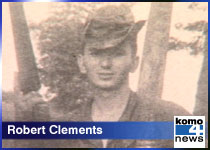
Seattle native Bob Clements was killed in Vietnam on Nov.
29, 1969 while on patrol with his rifle platoon. He was
attached to the Army's 35th Infantry Regiment, 1st Battalion,
Bravo Company.
On the day he died, Clements' squad was on point. At
midday, the platoon took a break to eat.
The squad sergeant ordered Bob and his best friend Jim
McCarthy to position themselves about 15 yards ahead of the
main body of the squad for security and early warning.
A few minutes later, the platoon was ready to move out. As
a precaution, the platoon commanding officer ordered a mortar
round to be detonated about 100 yards ahead of Bob's squad to
flush out possible unfriendlys.
However, instead of traveling 100 yards, the mortar
misfired and only went about 15. It landed between Bob and
Jim.
Jim was killed almost instantly. Bob died hours later in
surgery.
Two days later, an Army staff car arrived at the Clements'
home in Seattle. Bob's Mom Helen was told her son wouldn't be
coming home and had died heroically in battle. Bob's little
brother Rick couldn't believe the news was true.
A few days later, a telegram arrived confirming Bob's death
in Vietnam. The telegram, however, noted Bob had died as a
result of "friendly fire." The family was never told anything
beyond that.
Little brother Rick grew up bitter, hating the Army. He
always wondered which trigger-happy, macho commandos had
killed his big brother. Helen had trouble accepting her son's
death and rarely talked about it.
Meanwhile, the sergeant served his year in Vietnam and got
out. During the year he spent in-country, the sergeant lost
just two men---Bob and Jim. He returned home and eventually
settled in Florida.
For more than 30 years, he was haunted by that loss and
blamed himself. He never stopped thinking "what if…"
In Seattle, Rick endured more than 30 years of anger and
bitterness. More than 3,000 miles away in Florida, the former
sergeant endured more than 30 years of guilt.
Bitterness and guilt. Two powerful, destructive emotions.
Emotions that too often fester and go unresolved…
Fast forward to spring 2002. Rick Clements, now a
45-year-old protection officer for King County Courts
accidentally stumbles across the Virtual Wall Web site while
surfing on his home computer one day. The Virtual Wall lists
information on each of the more than 58,000 names on the
Vietnam Veterans Memorial.
Rick types in the name of his brother Robert Clements and
sees the basic information about Bob's death. And he sees one
other thing -- a remembrance posted by a man who served in
Bob's outfit.
Rick reads the remembrance, a poignant poem dedicated to
fallen members of the 35th Regiment. At the bottom of the poem
is an address for the Regiment's Web site. Rick goes to this
site and sees links to personal Web sites of four men who
served with the 35th in Vietnam.
One of the Web sites is titled "Dave's Vietnam Pics." Rick
clicks on Dave's Web page and scans some of the photos. The
hair on the back of his neck stands at attention when he sees
one particular photo.
It's a picture of his brother Bob in Vietnam -- a photo he
has never seen before. Bob with a cigarette in his mouth is
kind of smirking at the camera. The caption on the photo
mentions Bob's name and that he died as a result of friendly
fire.
Sensing that he's stumbled onto something extraordinary,
Rick searches other parts of Dave's Web site. One section is
entitled "Stories." And in the table of contents is one story
that takes Rick's breath away: "Bob and Jim's Last Meal."
Fighting through the tears, Rick reads the actual
accounting of his brother's death. It's a story he's never
heard and it reveals details the family has never known.
While reading the story, Rick realizes it was written by a
man who blames himself for the deaths of Bob and his best
friend, Jim.
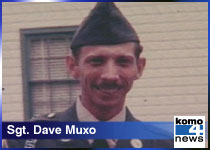
The author is Dave Muxo, the former sergeant who ordered
Bob and Jim to station themselves 15 yards ahead of the squad
that fateful day.
Though his mom has always had trouble dealing with Bob's
death, Rick shares the news with her of what he has found.
It's news that opens old wounds and Helen is reluctant to
pursue the matter further.
Rick, however, is pumped. Following more than 30 years of
bitterness, Rick for the first time is finding answers to
questions never answered. And he's discovered that at least
one man who served with his brother has suffered just as much
in his own way.
A link on Dave's Web site provides an e-mail address. Rick
sends Dave a message. A day later brings a heartfelt response
that washes away more resentment and bitterness.
It also brings an invitation. Each summer, Dave attends the
annual reunion for the 35th. As providence would have it, the
2002 reunion is in Seattle for the first time ever.
Dave invites Rick to be his guest at the banquet on
Saturday, July 27. Rick accepts.
KOMO-TV and "Dogtags" producer Doug Tolmie learned of the
story about three weeks before the reunion. He first contacted
Rick to get his permission to do the story. Permission is
granted and Doug sets up an interview at Rick's house three
days before the banquet.
He then fires off an e-mail to Dave Muxo telling him about
the story and requesting permission. A week goes by and no
response from Dave.
Doug asked Rick if he has a phone number for Dave. He
doesn't. Another day passes and no response. Doug contacts one
of the organizers of the reunion to see if he can confirm Dave
will be coming to Seattle. The organizer confirms that Dave
plans to arrive. The organizer further confirms that he and
other members of the 35th will support the story and do
whatever they can to facilitate it.
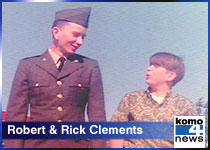
On July 24, Doug and photojournalist Bill Strothman
interviewed Rick at his home. Additionally, they received
several photos including one of Rick looking up at his big
brother Bob in uniform. Other poignant photos show Bob and his
mom.
The following day, Doug got a call from one of the reunion
organizers that Dave is expected to arrive by noon. A meeting
with Dave is set for 3 p.m. that afternoon at the Doubletree
Inn near Sea-Tac Airport. Doug arrives at 3, but Dave is a
no-show. He still hasn't arrived.
The next morning, Doug gets the call that Dave has finally
arrived and a meeting is set for 2 p.m.
This time, the long-awaited meeting happens. Dave, who
works as a computer programmer at Disney World in Orlando and
who looks a little like Roy Disney, is happy to do the story
and is anxious to meet Rick.
The most pressing remaining question is where to have the
meeting happen. Dave is asked if the TV crew wasn't there and
Rick arrives Saturday afternoon, where would Rick find Dave?
Dave says he will be next to the hospitality suite on the
Penthouse Floor. As the Webmaster for the regiment's Web site,
he'll be scanning photographs of men killed in action in
Vietnam while serving with the 35th. It's decided that this is
the place where the meeting between Rick and Dave will happen.
Following the meeting with Dave, Doug calls Rick to tell
him everything is set for Saturday. The interview with Dave
will occur at 2 p.m. and Rick is asked to arrive at 4.
Saturday afternoon, Dave is interviewed in the scanning
room. The interview is exceptional and emotional for all
involved. Dave breaks down a couple of times. During the
interview, Doug realizes that the room is not the best place
for the meeting between Rick and Dave. It's too sterile and a
meeting there just doesn't feel right.
Following the interview, Dave reveals that all the veterans
attending the reunion are assembling in the lobby a little
after 4 p.m. to take a group photo outside the hotel. Doug
decides to seize this unexpected opportunity and to use the
assembly in the lobby as the location for the meeting between
Rick and Dave.
The mission is to capture an exceptionally private moment
in a public place filled with more than a hundred veterans and
their families.
Rick pages Doug to tell him he has arrived and is waiting
in the bar. Doug tells Dave to head down for the group photo
and Rick will find him.
Doug and Bill Strothman beat Dave to the lobby and find
Rick waiting in the bar. They put a wireless mike on Rick and
tell him the plan has changed for the meeting. Instead of
meeting Dave upstairs near the hospitality room, Rick will
have to find Dave in the lobby amongst all the veterans
waiting to take the group photo.
Bill and Doug follow Rick as he heads to the lobby where
more than a hundred veterans have gathered. Each is a wearing
a nametag.
Rick walks around searching. Occasionally he asks if anyone
has seen Dave Muxo. A couple of veterans say they most
recently saw Dave upstairs in the hospitality room and that
he's probably somewhere in the lobby waiting for the group
photo.
Rick searches for a couple of minutes. To cut to the chase,
Bill positions himself next to Dave and subtly indicates with
his camera that Dave is next to him. It's too subtle for Rick.
Finally, Doug gently points Rick in the right direction.
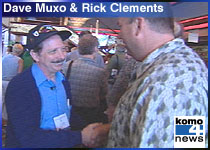
Rick sees Dave's nametag and immediately gives a bear hug
to the man who has endured more than 30 years of guilt over
Bob Clements' death. The poignant moment is captured. Mission
accomplished. More than 30 years of bitterness meets more than
30 years of guilt. And a new life-long friendship is formed.
When people see this story on television in November 2002,
they will see this incredible moment and they will think the
story is over. But it isn't. For something even more
extraordinary happened that Saturday.
When Doug and Bill found Rick waiting for them in the bar,
they were surprised to discover that Rick had brought an
unexpected guest. His mom, Helen.
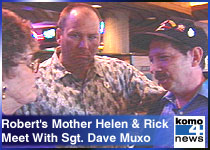
Though Helen wanted to go with Rick to find Dave in the
lobby, Doug, recognizing that there were now two poignant and
important moments to capture, asked her to remain behind. Doug
asked Rick to bring Dave to her.
As poignant as the meeting was between Rick and Dave, the
meeting between Dave and Helen was more important. Why? When
military personnel are under fire and the only thoughts are
those of surviving to go home, most who are not married think
first and foremost of going home to their mom. Girlfriends,
fathers, brothers and sisters are important. But none can
compare to the need to see mom.
When moms lose sons in combat, everyone feels their pain.
For anyone who saw "Saving Private Ryan" who can forget the
indelible scene where a mom watched three Army staff cars
drive up her dusty farm road to bring the shattering news
three of her boys wouldn't be coming home.
Thirty years of bitterness and 30 years of guilt were all
resolved instantly when a mom told a former Army sergeant that
her son's death wasn't his fault.
 Use the time-line above to navigate through different periods